News and analysis
AI on a device: operating the model matters beyond one fast answer
Liquid AI, Red Hat and Vercel address models, edge operations and cloud access. Verify execution location and the version lifecycle.
A camera or sensor sits near equipment, and the workflow needs a result without a long network round trip. A local model may be one option. After the demonstration, the team still owns updates, result checks and device management. Three October publications help separate those responsibilities from model selection.
Output format determines the model’s role
On 7 October, Liquid AI introduced open d1 models: d1-3B for text and images, and experimental d1-omni-600M with a different input arrangement. They target structured decisions in one forward pass. Reported performance belongs to the vendor’s devices and methodology, not every customer controller.
Start with a bounded question. A model might propose an observation category that an application rule subsequently checks. A probability in the response does not itself determine what equipment is allowed to do or who owns an uncertain result.
A device needs a verified version
On 8 October, Red Hat discussed edge MLOps, including heterogeneous hardware, accelerator dependencies, messaging and model lifecycle. A successful laptop experiment does not describe maintenance of a device fleet.
The design task is to preserve the model version, input requirements and compatible execution environment. Before an update, establish which devices receive the package and how to verify outcomes. A device that remains behind needs a distinguishable old version rather than being hidden in an apparently current fleet status.
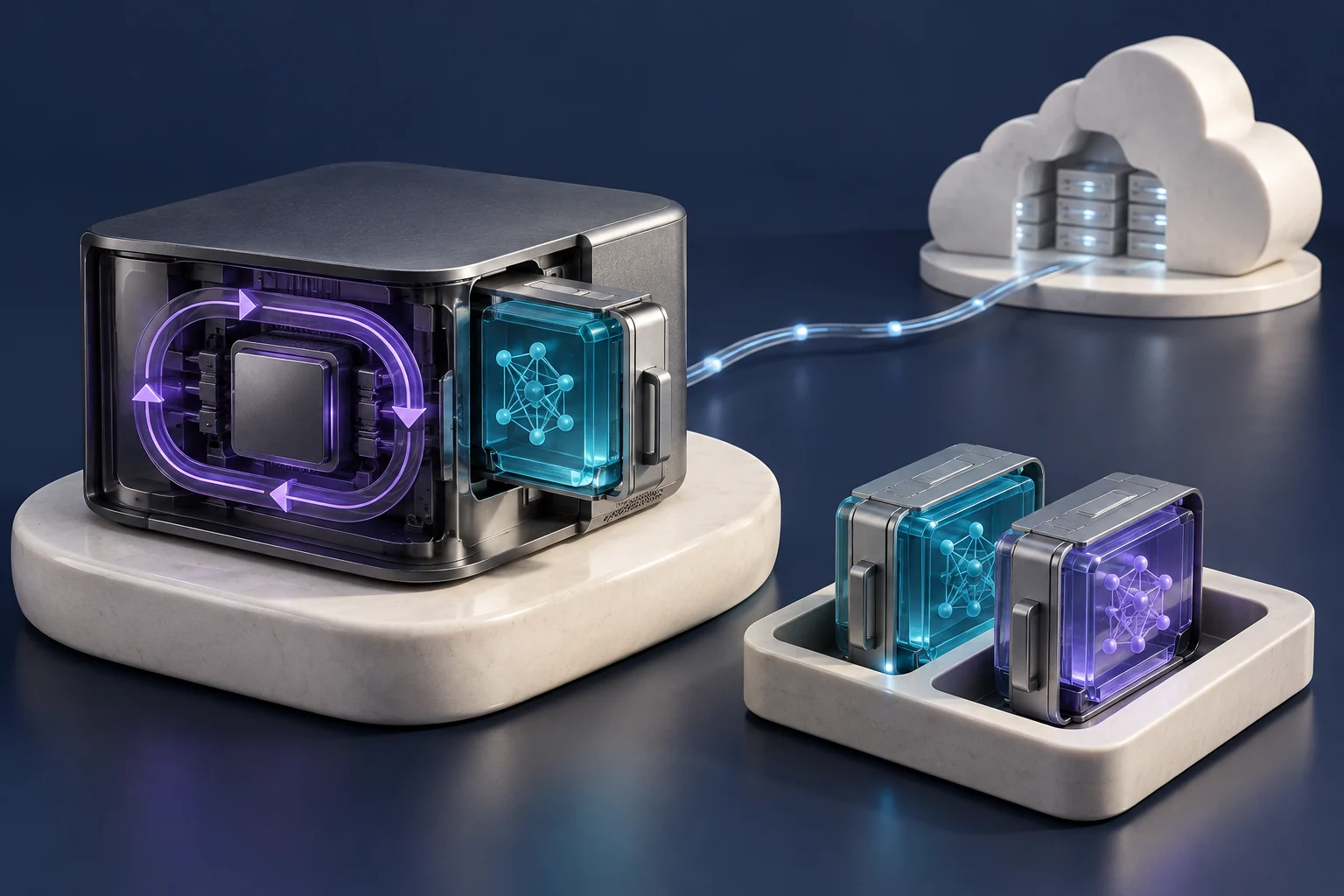
Cloud access is a separate execution location
On 9 October, Vercel added Liquid AI d1 to AI Gateway, with typed answers and probabilities. This is a cloud access route. It is not an announcement of an automatic backup channel for every edge product.
The sources connect three questions: what executes, where it executes and how the version is maintained. If a project needs local-to-cloud fallback, its conditions, transferred data and result comparison require their own design. A shared model-family name does not establish operational compatibility.
Verify the observation journey
In a test environment, prepare approved inputs, a connection outage and a model update. Check output format, execution time on the actual device and error state. Initially, the output can remain advice for an operator. Physical control requires a separately agreed action rule.
Assign an owner for releases and a way to identify the active version. Our server core guide helps explain coordination. The greenhouse controls project confirms equipment-to-interface work without claiming these AI models were used. For your infrastructure project, discuss devices, execution location and the update process.